Wildlife · 7 min read
Banyan Tree Monsters or Eco-Heroes? The Truth About Pakistan’s Bats
Pakistan has around 50 bat species, and almost everything we were told about them is wrong. What flying foxes actually eat, the real disease risk, and why heat and axes are thinning their roosts.
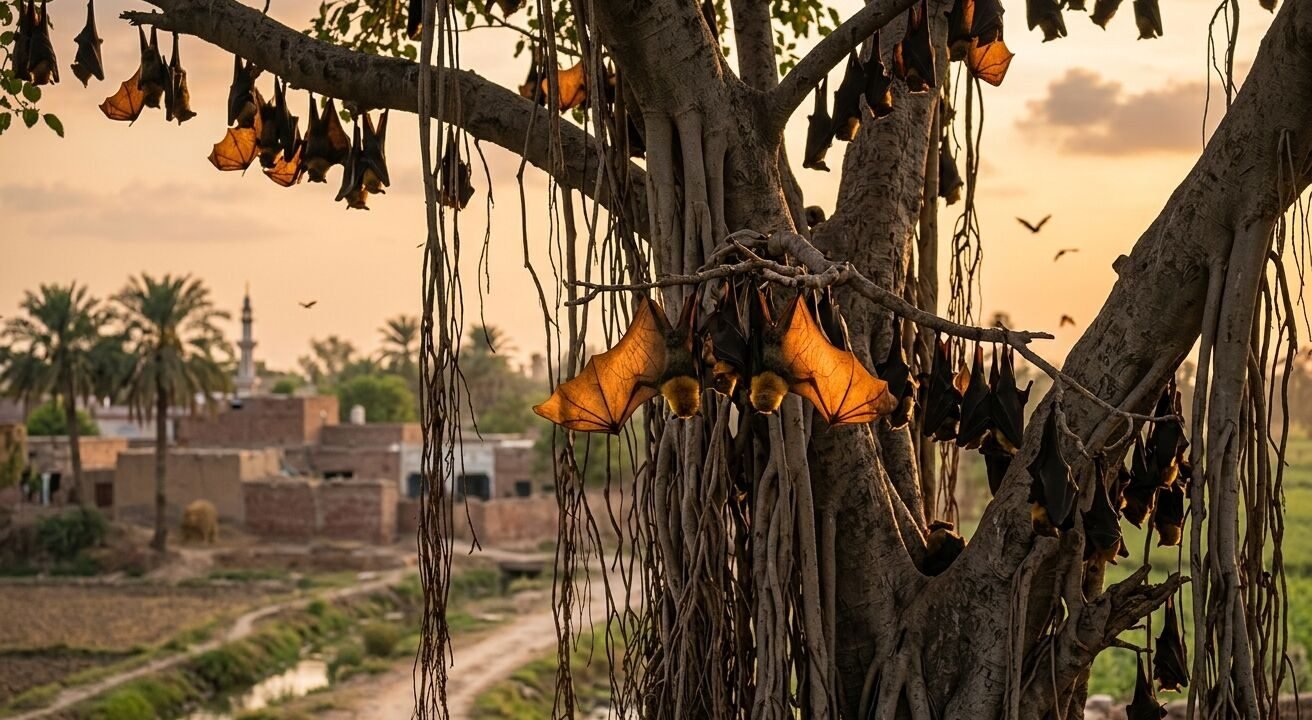
Walk past an old roadside tree at dusk anywhere in Punjab and you may see them leave: dark shapes dropping off the branches, wings wider than your outstretched arms, heading out over the fields. Most of us grew up being told what they were. Bad luck. A sign of a haunted house. Creatures that drink blood or tangle themselves in your hair.
When it comes to Pakistan bats, almost none of that is true. What is true is more interesting, and some of it should worry us.
Pakistan bats: fifty species, most of them small
Pakistan has around 50 species of bat, according to T. J. Roberts’ Mammals of Pakistan, which makes bats roughly a quarter of all the mammal species in the country. A checklist of Pakistan’s bats is now maintained online by the Journal of Threatened Taxa.
Only four of those species eat fruit: the short-nosed fruit bat, the Egyptian fruit bat, the fulvous fruit bat, and the one everyone notices, the Indian flying fox (Pteropus medius). Every other bat in Pakistan eats insects. They are small, fast and mostly unseen, living in old buildings, wells, tree hollows and roof spaces.
The “monster” in the tree
The Indian flying fox is the largest bat on the subcontinent, with a wingspan of up to about four feet. It roosts in the open, in large and noisy colonies, often in the same trees for years. That habit is where most of the ghost stories come from.
It is also a vegetarian. Flying foxes eat fruit, nectar and flowers, and they find them by sight and smell rather than echolocation. A year-long study in two Lahore parks identified the seeds of 32 plant species in what the bats dropped, and found the largest summer roosts in shisham trees.
They are not newcomers here, but they may be partly our doing. A note written from Gurdaspur in 1931 pointed out that earlier naturalists had not recorded flying foxes in the Punjab at all, and suggested that the spread of irrigation and orchards had made the province liveable for them. If that is right, the canal colonies of this region helped bring them in.
Myths, checked
They drink blood. No bat in Pakistan does. The only blood-feeding bats in the world live in Central and South America.
They are blind. Fruit bats have large eyes and see well at night. Insect-eating bats can see too, and add echolocation on top.
A bat in the house means death. It usually means a young bat took a wrong turn. Switch off the lights, open a window, and leave the room.
Bat fat cures joint pain. There is no evidence for this, and handling or cutting up bats is exactly how people expose themselves to disease.
What Pakistan bats do for us
Fruit bats move pollen between trees at night and carry seeds well away from the parent tree. Researchers working on the species in India estimate that flying foxes can carry seeds more than 100 kilometres, and that around 200 Indian tree species depend on bats for pollination, including semal, the silk cotton tree.
The insect-eaters are a different kind of help. They hunt moths, beetles and mosquitoes over farmland and towns every night. For a district that grows cotton and sprays heavily, that is free pest control we rarely think about.
The real problems
Being fair to bats means being honest about the conflict too. Flying foxes do eat cultivated fruit, and orchard owners lose some of their crop to them. Netting and timely harvesting are the usual answers. Killing them removes the same animals that pollinate the trees.
The bigger risk to people is disease, and it is worth stating plainly. The World Health Organization identifies fruit bats of the family Pteropodidae, which includes the flying fox, as the natural host of Nipah virus. Human cases have so far been reported in Bangladesh, India, Malaysia, the Philippines and Singapore, not in Pakistan. WHO’s advice is simple: wash and peel fruit, throw away any fruit with bite marks, and boil freshly collected palm sap.
Bats can also carry rabies. Do not touch a bat, alive or dead, and if you are bitten or scratched, wash the wound with soap and water and see a doctor the same day.
What is happening to them
In November 2022, villagers near Shikarpur in Sindh killed a flying fox with a wingspan of more than four feet, saying the bats were frightening children and damaging fields. A Sindh Wildlife Department officer responded that the animals were harmless herbivores and that his teams had been running awareness campaigns to stop farmers killing them.
Fear is only one threat. A 2022 to 2024 study by researchers at the University of Veterinary and Animal Sciences followed 15 flying fox roosts in Okara, Kasur and Lahore. It recorded a 1.7% fall in bat numbers over two years, mainly at unprotected sites where people disturb the roosts, while numbers inside Changa Manga forest stayed steadier.
Then there is heat. Flying foxes hang in exposed branches through the day, which leaves them vulnerable in a heatwave. A research project on the species in Pakistan notes that extreme heat and the local disappearance of flying foxes in the south of the country seem to be related, and heat-stress deaths have been recorded as far north as Haripur. In May 2024, flying foxes died in large numbers across the border in Rajasthan, which shares our climate.
Flying foxes usually raise one pup a year. A colony that is cut down, burnt out or cooked by a heatwave does not bounce back quickly.
What we do not know about Bahawalpur
We looked for a published count of flying fox roosts in Bahawalpur division and did not find one. The roost studies we could find are from Lahore, Okara, Kasur and Khyber Pakhtunkhwa. We also could not confirm what protection, if any, bats have under Punjab’s wildlife law. India moved the flying fox out of its vermin schedule and into a protected one in 2022.
That gap is something readers can help close. If you know a tree, a park or an old building in the district where bats roost, tell us where it is and roughly how many you see at dusk. We will map the roosts and publish what we find. It is the same gap we found with the Lal Suhanra blackbuck: an animal everyone talks about, and no recent count. You can read more about the district’s wildlife on our wildlife page.
So, monsters or eco-heroes?
The trees our grandparents called haunted were full of animals that pollinate, plant and protect crops while we sleep. Pakistan bats are not dangerous if we leave them alone, and they are losing ground to axes, fear and heat. The least we can do is stop throwing stones at them, and keep the old trees standing.
Sources
- Roberts TJ, Mammals of Pakistan, revised edition, 1997, as cited in Khan W et al., “Roosting ecology and morphometric analysis of Pteropus medius in Lower Dir”, Brazilian Journal of Biology. Read the paper
- Srinivasulu C, Srinivasulu A, Srinivasulu B, “Checklist of the bats of Pakistan (v1.2)”, Journal of Threatened Taxa, 2026. View the checklist
- “Proximate analysis of Indian flying fox’s natural food, with a note on its roost variations in urban areas of Lahore”, Turkish Journal of Zoology 41(4). Read the abstract
- “Roost site selection and seasonal dynamics of the Indian flying fox (Pteropus medius)”, University of Veterinary and Animal Sciences, Lahore. Read the paper
- Breadon C, “The occurrence of the flying-fox in the Punjab”, Journal of the Bombay Natural History Society, miscellaneous notes. Read the note
- Ahmed T, “Effect of extreme heat events on Indian flying foxes in Pakistan”, Rufford Foundation project. Project page
- “Can India save its fruit bats from the rising heat?”, Dialogue Earth. Read the article
- “Villagers hunt down ‘harmless’ giant bat in Sindh”, ProPakistani, November 2022. Read the report
- World Health Organization, Nipah virus fact sheet, January 2026. Read the fact sheet
This piece is desk research from published sources, not EcoBahawalpur field data. Where we have our own readings we say so.