Air · 4 min read
Why Bahawalpur smog in winter is not only Lahore’s problem
Kilns, crop residue and traffic are province-wide sources. The published numbers show where Punjab air pollution comes from, and how little of the reporting reaches south Punjab.
Every year from about late November the country has the same conversation, and it is a conversation about Lahore. The AQI screenshots are from Lahore. The school closures are in Lahore. The court orders are heard in Lahore. Meanwhile the haze sits over Bahawalpur too, and almost nobody writes it down.
That is not because the sources are different down here. It is because the measuring and the reporting stop about three hundred kilometres north of us.
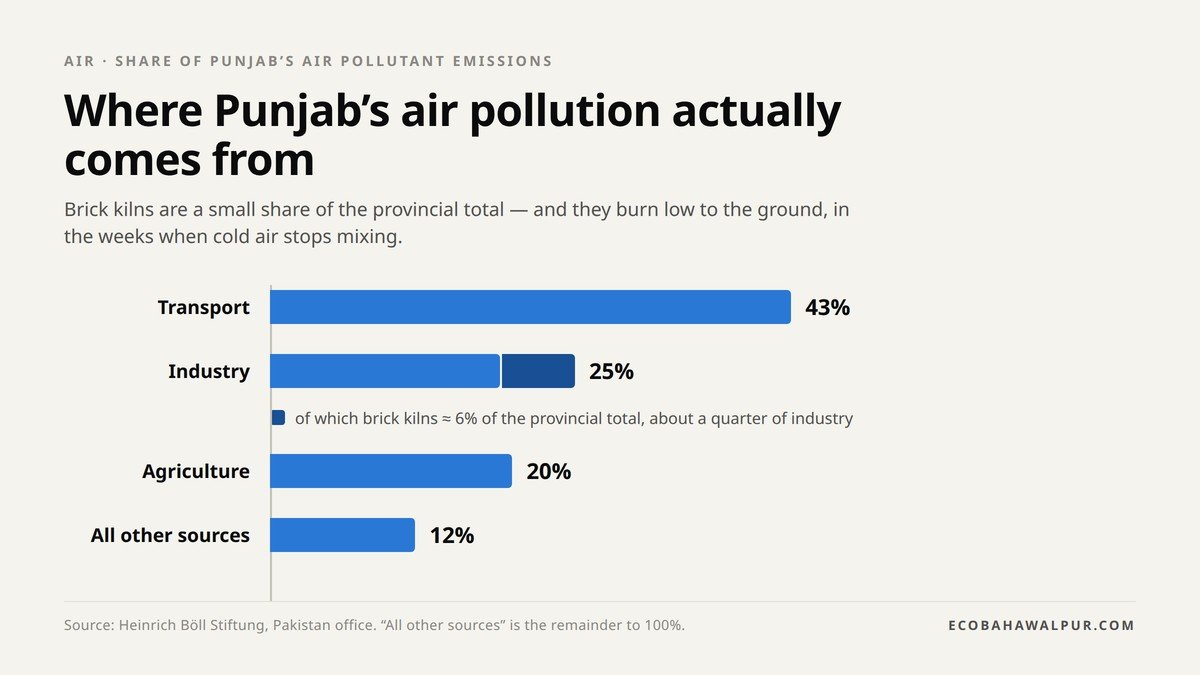
Where Punjab’s air pollution actually comes from
The provincial breakdown is not really in dispute. According to figures published by the Heinrich Boll Stiftung’s Pakistan office, transport is the largest single contributor to air pollutant emissions in Punjab at 43 per cent, followed by industry at 25 per cent and agriculture at 20 per cent. Brick kilns account for about a quarter of that industrial share, which puts them at roughly six per cent of the provincial total.
Six per cent sounds modest until you notice two things. Kiln smoke is released low to the ground, near where people live, and it peaks in exactly the weeks when cold air stops the atmosphere from mixing. A source that would disperse in June sits on top of a town in January.
The kilns, and the fix that already exists
Punjab has somewhere around 7,500 to 8,000 brick kilns. Lok Sujag counted 7,530; the Boll Stiftung puts it at roughly 8,000. Either way it is thousands of coal-fired chimneys spread across the province, including ours.
The fix is not experimental. Zigzag firing rearranges how bricks are stacked so hot air travels a longer, folded path through the kiln, which transfers heat far more efficiently. The published gains: about 20 per cent less coal, 40 to 60 per cent lower carbon emissions, and an estimated 15 per cent cut in province-wide air pollution if the conversion were completed. Kiln owners also report better bricks, with 90 per cent grading A against much lower grades before. One owner quoted by Lok Sujag reported coal use down 30 per cent and daily output doubling from 30,000 to 60,000 bricks.
So why is it not done? Cost and enforcement. Converting a kiln runs about 600,000 to 700,000 rupees. Two billion rupees was allocated under the Green Development Programme in 2017 to help, but Lok Sujag reported that none of it had reached kiln owners. The Lahore High Court ordered polluting kilns closed from 7 November 2020 and the province set a conversion deadline of 31 December 2020. By that November, 1,268 kilns had converted. Under twenty per cent.
The south Punjab blind spot
Read the reporting on kiln conversion and one thing stands out. Lok Sujag’s investigation, which is among the most detailed published on the subject, covers Faisalabad, Lahore and Kasur. It carries no figures for southern Punjab at all. That is not a criticism of the reporters. It reflects where the enforcement drives, the court attention and the monitoring budget have gone.
We could not find a published district-level count of how many kilns around Bahawalpur have converted to zigzag, how many were inspected, or how many were sealed in any smog season. If that record exists, it is not where a member of the public can read it.
Monitoring has improved. The Punjab government now runs a public AQI dashboard, and Bahawalpur appears on the national sensor network. That is real progress from a few years ago. But a single reading for a district of this size, with no published kiln inventory beside it, tells you the air is bad without telling you what to do about it.
What follows from this
Smog here is not weather that happens to us. It is combustion, and combustion has owners and addresses. The winter figures on our own homepage snapshot come from a public model, not from a monitor at the end of your street, and we say so on the page. Nobody should be satisfied with that, us included.
Two things are worth asking for by name. A district kiln inventory for Bahawalpur, published, with conversion status against each entry. And a reason why the 2017 support money did not reach the people being ordered to spend 700,000 rupees each.
If you live near a kiln, or you run one, we want to hear what the last two smog seasons looked like from where you stand.
Sources
- “Zigzag way to end brick kiln pollution”, Heinrich Boll Stiftung Afghanistan/Pakistan, 21 February 2022. Read the article
- “Brick by brick: The deadly contribution of emissions from kilns in Punjab to winter smog”, Lok Sujag. Read the investigation
- Punjab AQI dashboard, Government of the Punjab. Open the dashboard
- Bahawalpur air quality station, World Air Quality Index project. See the readings
This piece is desk research from published sources, not EcoBahawalpur field data. Where we have our own readings we say so.