History & Heritage · 9 min read
Pakistan Independence Day (14 August): the real story of Youm-e-Azadi
Every 14 August, Pakistan marks Youm-e-Azadi. But why 14 August, when the Indian Independence Act named 15 August? A fact-checked guide to the 1947 timeline, the myths, and what the day means today.
Every year on 14 August, Pakistan stops and looks back. Green and white flags appear on rooftops in Bahawalpur, Lahore, Karachi and Gilgit. Children paint crescents on their faces. At dawn a 31-gun salute sounds in Islamabad, and a 21-gun salute in each provincial capital. In 2026, Pakistan marks its 79th Independence Day.
Behind the celebration sits a story more detailed, and more interesting, than the version most of us learned at school. This article sets out the verified history of 14 August 1947, explains why Pakistan and India celebrate a day apart, and separates well-documented facts from popular myths.
What is Youm-e-Azadi?
Youm-e-Azadi means simply Day of Freedom. It is Pakistan’s national day, marking the end of British rule over the subcontinent and the creation of a sovereign Pakistan in August 1947.
It is a public holiday across the country. Government buildings are lit up, the national flag is raised at official ceremonies, and the President and Prime Minister address the nation.
Note: Independence Day (14 August) is not the same as Pakistan Day (23 March). Pakistan Day commemorates the Lahore Resolution of 1940 and the adoption of Pakistan’s first Constitution in 1956.
Timeline: the road to 14 August 1947
The creation of Pakistan was not a single event. It was the outcome of decades of constitutional debate, elections and negotiation.
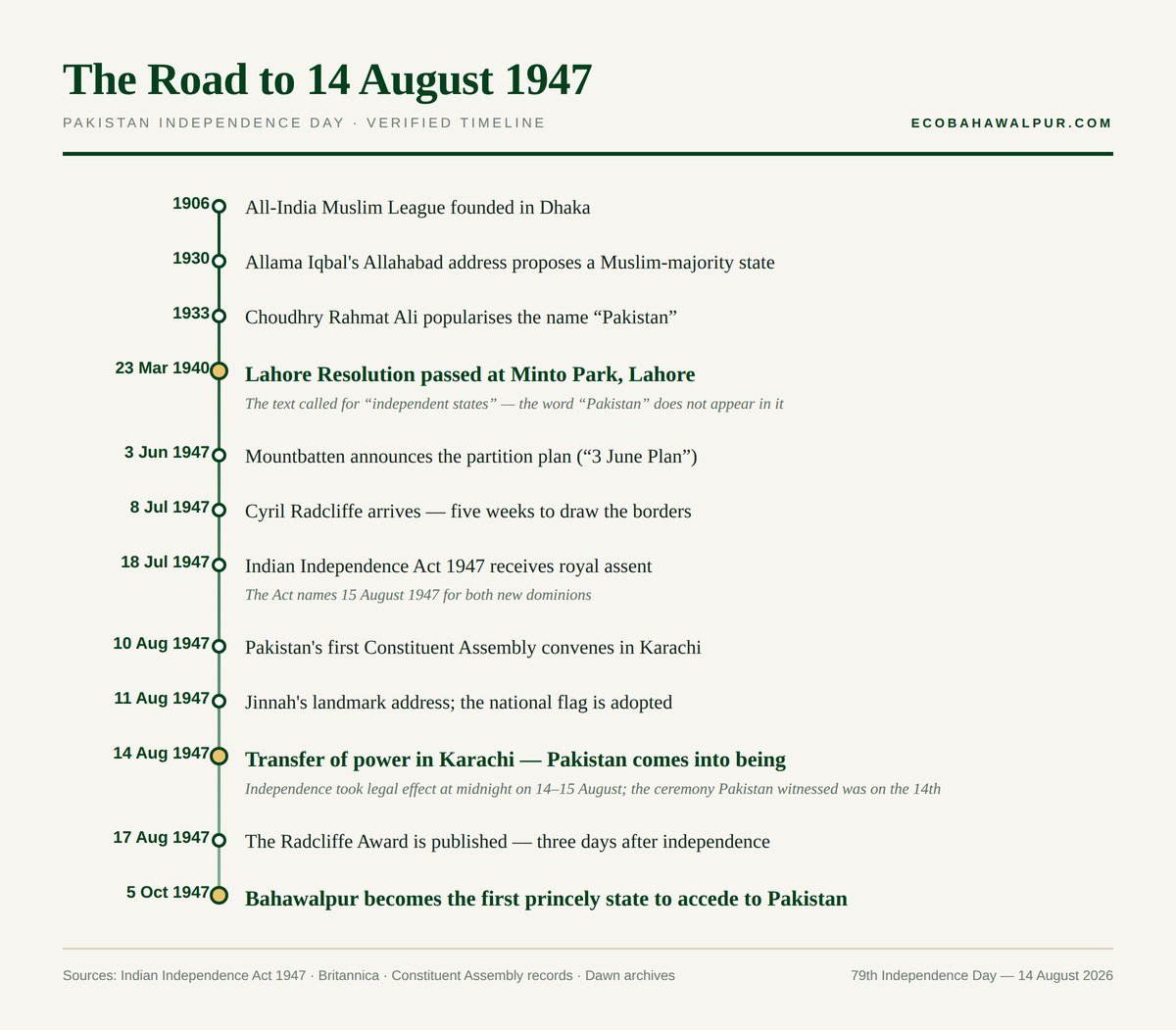
| Date | Event |
|---|---|
| 1906 | The All-India Muslim League is founded in Dhaka. |
| 1930 | Allama Muhammad Iqbal, in his Allahabad address, proposes a consolidated Muslim-majority state in north-west India. |
| 1933 | Choudhry Rahmat Ali circulates the pamphlet Now or Never, popularising the name Pakistan. |
| 23 March 1940 | The Lahore Resolution is moved at the Muslim League session at Minto Park (now Iqbal Park), Lahore, by A. K. Fazlul Huq. |
| 1945-46 | Elections give the Muslim League a decisive mandate among Muslim voters. |
| 3 June 1947 | Viceroy Lord Mountbatten announces the partition plan, known as the 3 June Plan. |
| 8 July 1947 | Sir Cyril Radcliffe arrives in India with roughly five weeks to draw the borders of Punjab and Bengal. |
| 18 July 1947 | The Indian Independence Act 1947 receives royal assent in the British Parliament. |
| 10 August 1947 | Pakistan’s first Constituent Assembly convenes in Karachi. |
| 11 August 1947 | Muhammad Ali Jinnah delivers his landmark address on citizenship and religious freedom. The Constituent Assembly adopts the national flag. |
| 14 August 1947 | Power is formally transferred at a ceremony in Karachi. The Dominion of Pakistan comes into existence, with Muhammad Ali Jinnah as its first Governor-General. |
| 17 August 1947 | The Radcliffe Award, the actual boundary line, is finally made public, three days after independence. |
| 5 October 1947 | The princely state of Bahawalpur signs its Instrument of Accession, becoming the first princely state to accede to Pakistan. It was accepted on 9 October 1947. |
Why does Pakistan celebrate Independence Day on 14 August?
This is the most searched question about Youm-e-Azadi, and it deserves an honest answer.
What the law actually said
The Indian Independence Act 1947 used a single date for both new countries. Its opening words are unambiguous: as from the fifteenth day of August 1947, two independent Dominions were to be set up, to be known as India and Pakistan.
Legally, both dominions came into being at the stroke of midnight between 14 and 15 August 1947. The same moment, two dates.
Why 14 August became Pakistan’s day
1. The Karachi ceremony took place on 14 August. Lord Mountbatten could not be in two places at midnight. He flew to Karachi first, addressed Pakistan’s Constituent Assembly on the morning of 14 August 1947, transferred power, and then returned to Delhi for India’s midnight ceremonies. For Pakistanis, the public transfer of power happened on the 14th, and that is the day the country witnessed.
2. The date carried religious resonance. The night of 14-15 August 1947 fell in the last ten days of Ramadan 1366 AH, widely remembered as the night of 27 Ramadan, one of the most sacred nights in the Islamic calendar. Because the Islamic day begins at sunset, that night belonged to 27 Ramadan while the Gregorian calendar still read 14 August.
3. A separate date affirmed a separate identity. Marking 14 August gave the new state its own distinct national day rather than one shared with its neighbour.
An honest footnote
Historical honesty requires noting this: in Pakistan’s earliest months, 15 August was treated as the founding date. In a broadcast marking the birth of the new state, Jinnah himself described 15 August as the birthday of the independent and sovereign State of Pakistan. Pakistan’s first commemorative stamps, issued in July 1948, also carried 15 August 1947. Over the following years, 14 August became the settled date of national celebration.
This does not diminish Independence Day in any way. It reflects a real historical detail: independence arrived at midnight, and a nation chose to celebrate the day the transfer of power was witnessed on its own soil.
Pakistan’s 14 August and India’s 15 August: what is the difference?
Two neighbours, one midnight, two anniversaries. Here is the clearest way to see it.
| Pakistan | India | |
|---|---|---|
| Celebrated on | 14 August | 15 August |
| Legal date in the 1947 Act | 15 August 1947 | 15 August 1947 |
| Transfer-of-power ceremony | Karachi, 14 August 1947 | New Delhi, midnight 14-15 August 1947 |
| First head of state | Muhammad Ali Jinnah, Governor-General | Lord Mountbatten, Governor-General |
| 2026 anniversary | 79th | 79th |
The one-day difference is not a contradiction and not a competition. It reflects a single midnight recorded from two different capitals.
Facts versus popular myths
Independence Day generates a great deal of forwarded content each August, and some of it is inaccurate. Here is a careful comparison.
| Popular claim | What the record shows |
|---|---|
| The Indian Independence Act named 14 August as Pakistan’s independence date. | Myth. The Act named 15 August 1947 for both dominions. 14 August became Pakistan’s celebrated date in the years that followed. |
| The border between Pakistan and India was known on Independence Day. | Myth. The Radcliffe Award was completed in early August but published only on 17 August 1947, three days after independence. Millions moved without knowing which country they were in. |
| The Lahore Resolution of 1940 demanded a country called Pakistan. | Partly myth. The resolution called for independent states in Muslim-majority areas and did not contain the word Pakistan. The press soon labelled it the Pakistan Resolution. |
| The national anthem was sung at the 1947 independence ceremony. | Myth. The Qaumi Taranah was officially adopted in 1954: music by Ahmad G. Chagla in 1949, lyrics by Hafeez Jalandhari in 1952. |
| Independence Day and Pakistan Day are the same thing. | Myth. 14 August is Independence Day; 23 March is Pakistan Day. |
| Pakistan’s flag was adopted on 14 August 1947. | Close, but imprecise. The Constituent Assembly adopted the flag on 11 August 1947. It flew as the national flag from 14 August. |
The human cost of 1947
No honest account of Independence Day can leave this out. Partition triggered one of the largest forced migrations in recorded history.
- Historians estimate that 12 to 20 million people were displaced along religious lines, with roughly 14.5 million crossing the new borders in the years immediately after 1947.
- Punjab bore the heaviest movement, with an estimated 12 million people on the move within that province alone.
- Death-toll estimates from partition violence range widely, from around 200,000 to two million, with many scholars citing a figure near one million.
Remembering these losses is part of what makes 14 August meaningful. Freedom was not simply granted; it was paid for.
The significance of Independence Day in modern Pakistan
A shared national moment
For one day, a country of more than 240 million people does the same thing at the same time. Flag-hoisting ceremonies open the morning. Schools hold milli naghma competitions. Families visit the Minar-e-Pakistan in Lahore and the Mazar-e-Quaid in Karachi.
How Bahawalpur remembers
Bahawalpur holds a distinctive place in this history. As a princely state, it was the first to accede to Pakistan, signing its Instrument of Accession on 5 October 1947. Nawab Sir Sadiq Muhammad Khan Abbasi V went on to provide substantial financial support to the new state. Independence Day in Bahawalpur, with flag ceremonies around Noor Mahal, Sadiq Public School and Fareed Gate, carries that added layer of local pride.
Celebrating responsibly
Recent years have brought a welcome shift toward safer, cleaner celebration:
- Choosing quality flags and taking them down respectfully rather than letting them fall into the street.
- Avoiding aerial firing, which causes preventable deaths every August.
- Skipping single-use plastic buntings and cleaning up public spaces afterwards.
- Supporting local flag-makers and small businesses.
Patriotism is best expressed in ways that leave the country better than we found it.
Looking forward
Independence Day is also a moment to ask what the next year should look like, in literacy, in water conservation, in tree cover, in civic responsibility. The generation that built Pakistan handed over a country. Each generation since has been asked what it will hand on.
Frequently asked questions
When is Pakistan Independence Day 2026?
Friday, 14 August 2026. It is Pakistan’s 79th Independence Day.
Why does Pakistan celebrate on 14 August and India on 15 August?
Both countries became independent at midnight between 14 and 15 August 1947. Pakistan’s transfer-of-power ceremony was held in Karachi on 14 August, before Lord Mountbatten travelled to Delhi for India’s midnight ceremony, so each country marks a different calendar date for the same moment.
What does Youm-e-Azadi mean?
It is Urdu for Day of Freedom, and is the common name for Pakistan’s Independence Day.
Was Pakistan’s independence date ever 15 August?
In the earliest period, yes. The Indian Independence Act 1947 specified 15 August, Jinnah’s own broadcast referred to 15 August, and the first commemorative stamps of 1948 carried that date. 14 August became the established day of national celebration afterwards.
Who was Pakistan’s first Governor-General?
Muhammad Ali Jinnah, known as Quaid-e-Azam, who took office as Pakistan came into being in August 1947.
What is the difference between 14 August and 23 March?
14 August is Independence Day. 23 March is Pakistan Day, commemorating the Lahore Resolution of 1940 and the 1956 Constitution.
When was the Pakistan-India border finalised?
The Radcliffe Award was published on 17 August 1947, after both countries were already independent.
Which princely state joined Pakistan first?
Bahawalpur, which signed its Instrument of Accession on 5 October 1947.
Conclusion
Fourteenth August is not only a date on the calendar. It is the point where a long constitutional argument, an election mandate, a boundary line drawn in five weeks, and the journeys of millions of ordinary families all converge.
Understanding the real history, including the details that complicate the simple story, makes the day more meaningful, not less. Pakistan was created through law, negotiation and enormous human sacrifice. The best way to honour that is to know the story accurately, tell it truthfully, and build on it.
Pakistan Zindabad.
Sources
Indian Independence Act 1947 (royal assent 18 July 1947), UK Parliament; Encyclopaedia Britannica, Independence Day (Pakistan) and Partition of India; the historical record of the Radcliffe Line and the 17 August 1947 publication of the boundary award; Chaudhri Muhammad Ali, The Emergence of Pakistan (1967); Dawn archive reporting on Jinnah’s broadcast and the 1948 commemorative stamps; records of the Constituent Assembly of Pakistan, 10-14 August 1947; Bahawalpur district records on the Instrument of Accession, October 1947.